 bacb2daaa6
用 feat 完整版替换 dev 旧版:references 补 studio-rest-api + v2-overview/v2-building-blocks/v2-deploy(docs.agentscope.io 2026-06-22 快照),SKILL.md 补索引。

Co-Authored-By: Claude Opus 4.8 (1M context) <noreply@anthropic.com>
53 KiB
Agent Service
Host your agent as a multi-tenant, multi-session HTTP service
Agent Service is the FastAPI-based hosting layer that turns AgentScope agents into a multi-tenant, multi-session HTTP service. It owns everything around the agent — request routing, per-user resource lifecycle, session state, persistence, scheduling, and tool offloading — so that the agent code you wrote against Agent can serve production traffic without being rewritten.
What sets it apart:
- Production backbone for live agents — agent runs, background tasks, schedules, and the tool/MCP/skill/workspace lifecycle are managed end-to-end, with session streams that fan out to multiple subscribers and replay buffered history on reconnect.
- Schema-driven frontend — credentials publish JSON schemas and models expose declarative cards (input/output types, context size, parameter schemas), so the UI can render forms and capability badges without coupling to provider-specific code.
- Multi-tenant by construction — credentials, agents, sessions, schedules, and messages are all owned by the request's
user_id, and ownership is enforced at the routing layer — one deployment serves many users with no per-tenant code paths. - Modular and extensible — authentication, chat protocols, workspace isolation strategy, storage backend, and the set of model providers and credential types are all open at the boundary, swappable without touching framework code.
Capabilities
| Capability | Description |
|---|---|
| Agent teams | A leader agent spawns worker agents and coordinates them through built-in team tools; see the Agent Team chapter. |
| Workspace management | Pluggable workspace isolation (built-in: per-agent; extensible to per-session or per-user) for the agent's filesystem, MCP clients, and skills. |
| Background task offloading | Long-running tool calls move to background; their results are delivered back through the session's event stream when they finish. |
| Cron scheduling | Time-based agent execution with stateful or stateless sessions; schedules persist across restarts. |
| Session replay | Late-joining clients to the per-session SSE stream receive buffered history before live events, so multiple tabs or a reconnecting frontend stay in sync. |
| Protocol adaptation | Middleware-based conversion to external protocols (AG-UI, A2A, etc.) on top of AgentScope's native event stream. |
| Distributed deployment WIP | All shared state lives in Redis (storage + message bus), so multiple worker processes — or multiple nodes — can serve one logical service. |
Quickstart
The fastest way to see Agent Service in action is to run the bundled example backend together with the example frontend — both ship inside the AgentScope repo.
Try the bundled example
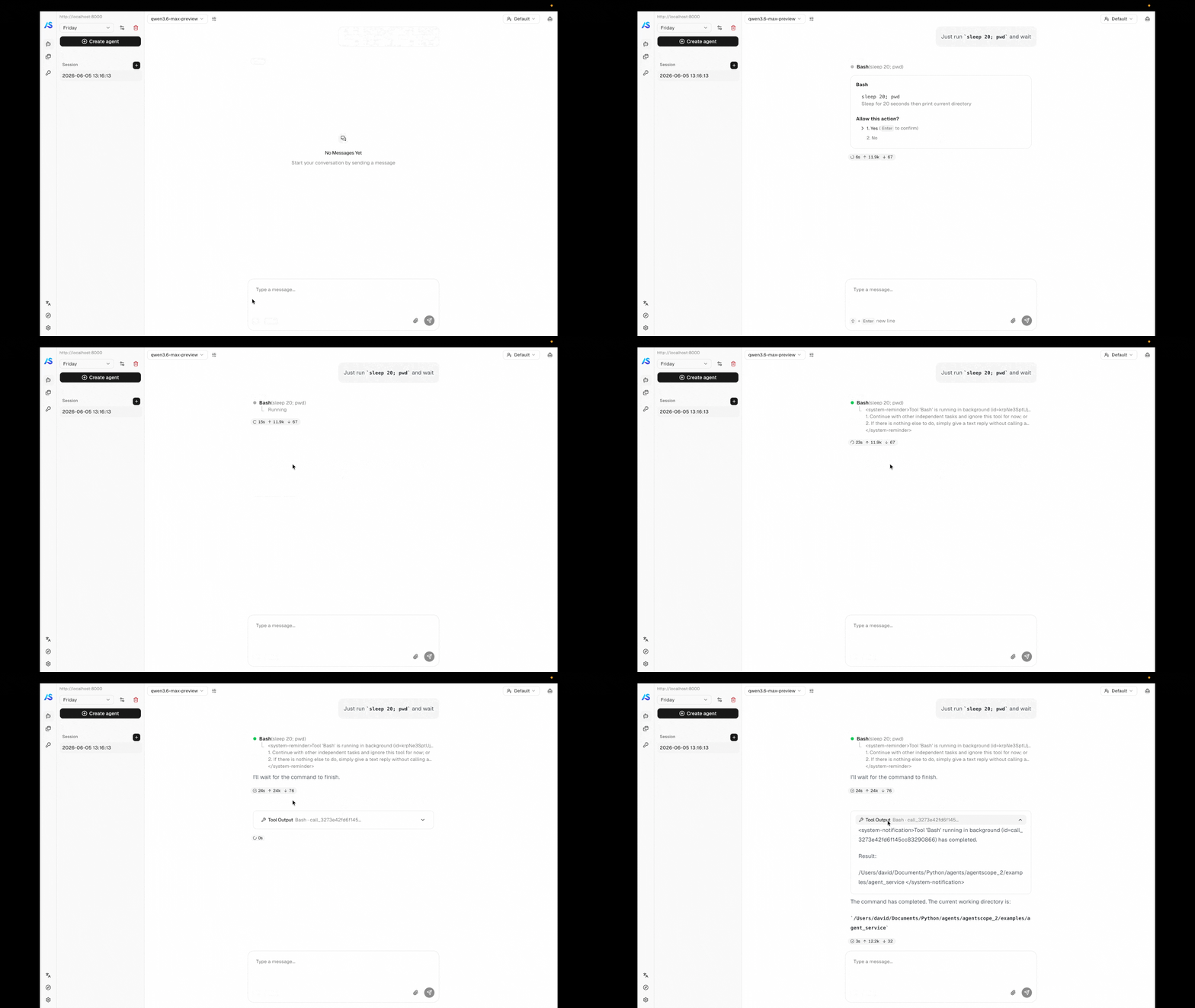
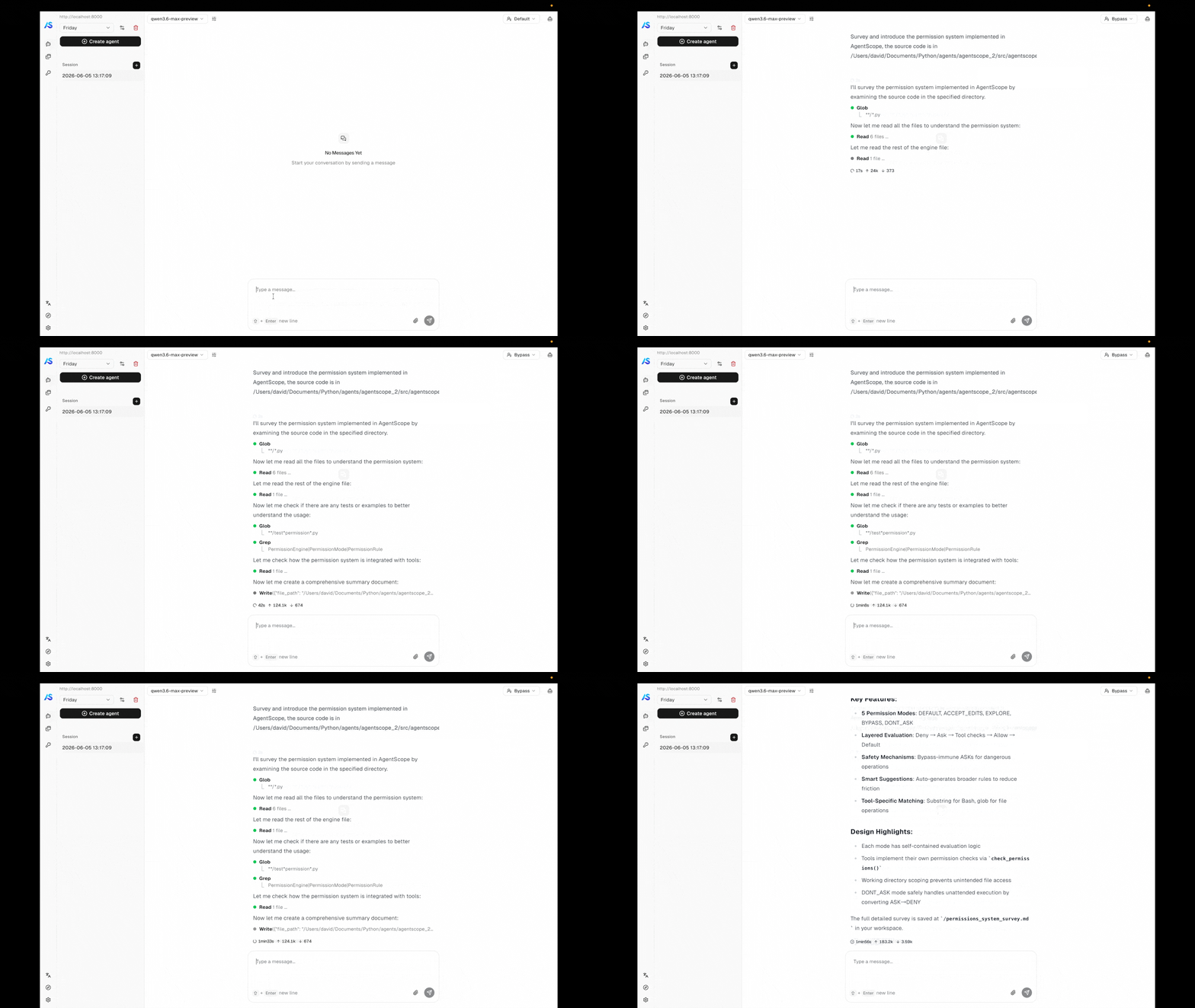
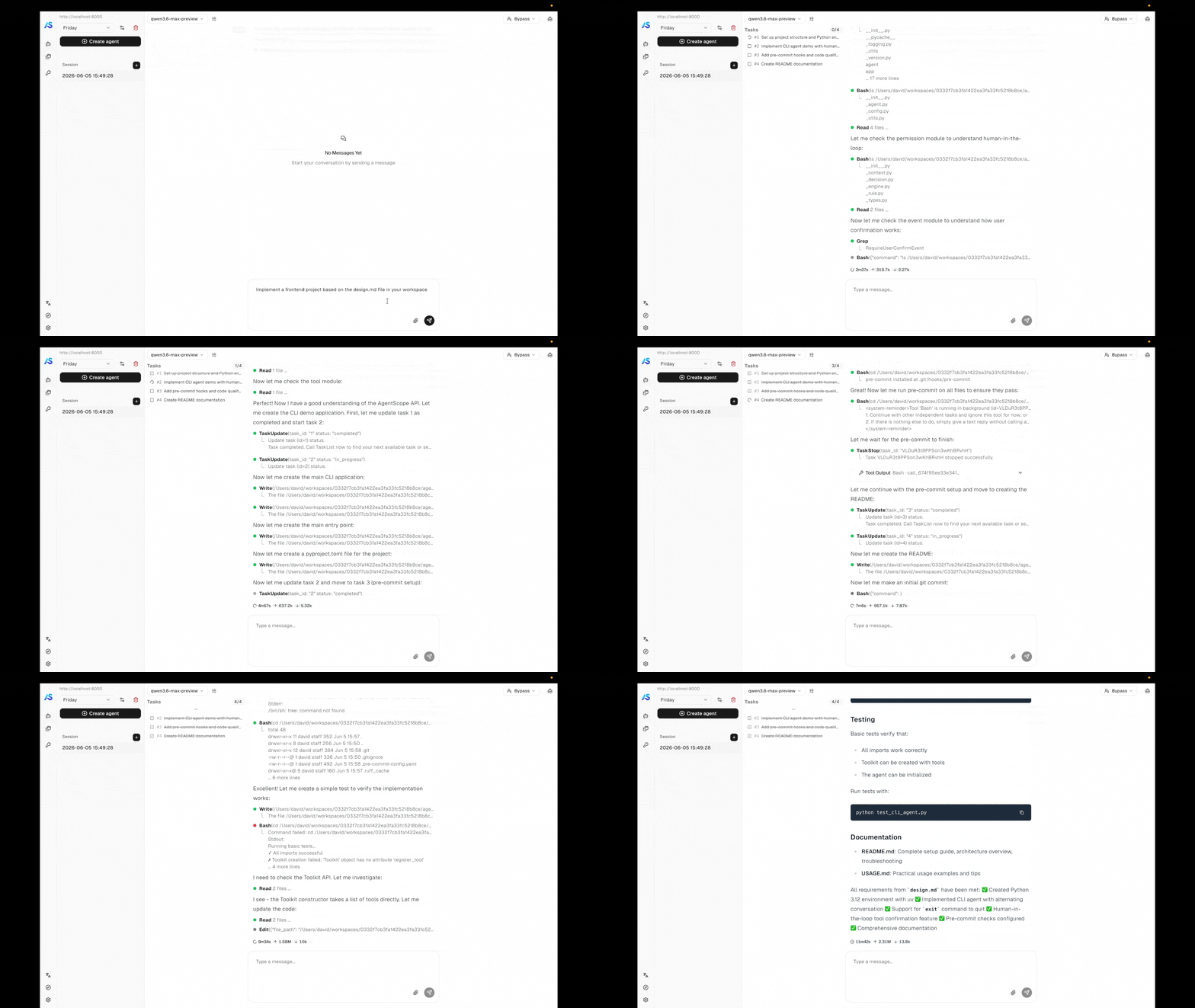
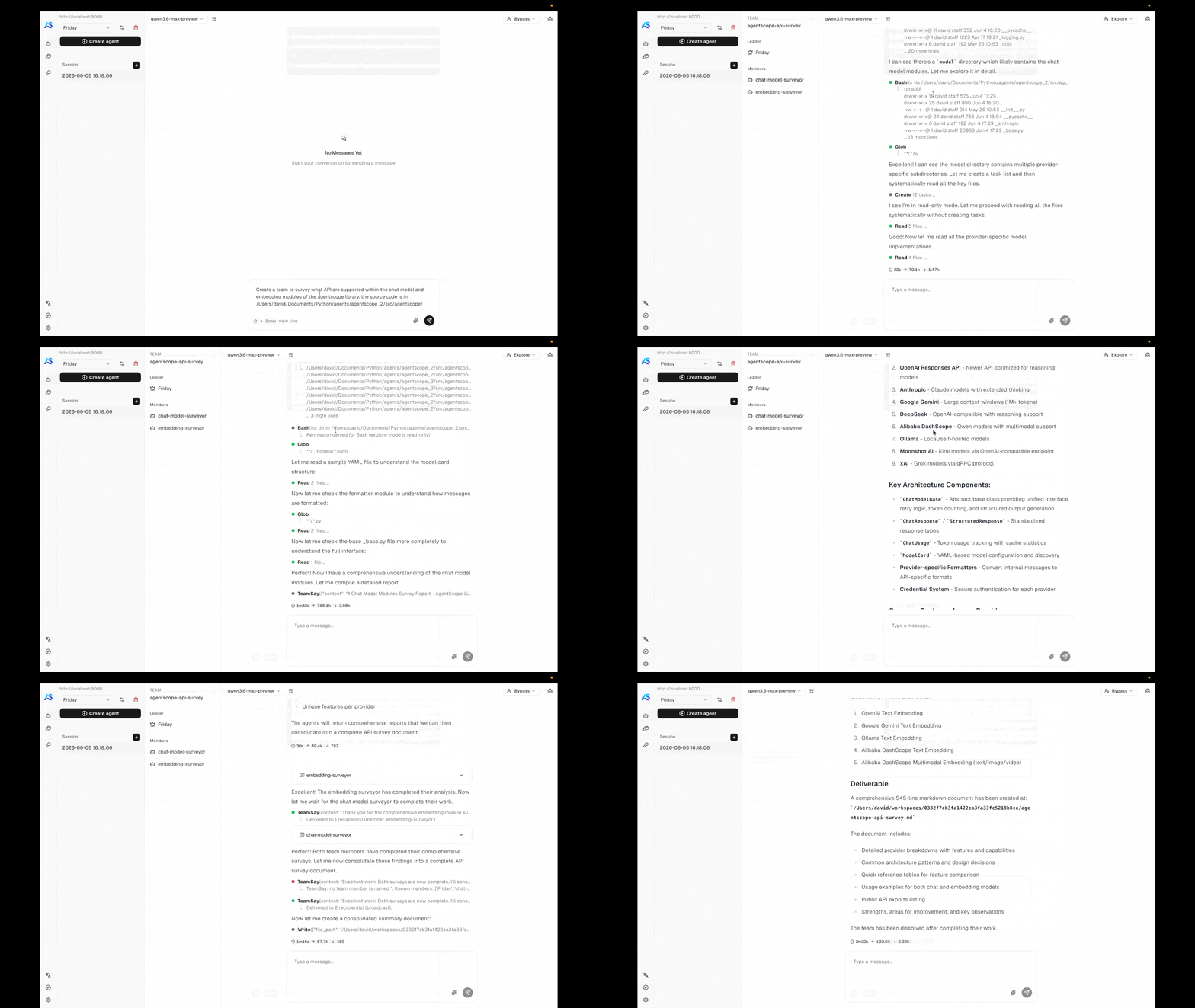
The examples/agent_service directory boots a ready-to-use service, and examples/web_ui is a matching React frontend that talks to it. Together they give you a working playground for every capability above in a few minutes.
 ```bash
git clone https://github.com/agentscope-ai/agentscope.git
cd agentscope
```
Make sure a local Redis is reachable (the example expects `localhost:6379`), then launch the service:
```bash
git clone https://github.com/agentscope-ai/agentscope.git
cd agentscope
```
Make sure a local Redis is reachable (the example expects `localhost:6379`), then launch the service:
```bash
cd examples/agent_service
python main.py
```

The service comes up on `http://localhost:8000`.
```bash
cd examples/web_ui
pnpm install
pnpm dev
```

Open the URL the dev server prints (typically `http://localhost:5173`) and the frontend will connect to the backend you started in step 2.
Once both are running, the same UI lets you exercise every capability the service ships with:
- Permission control — tools that touch the system pause for confirmation; explore-mode locks the agent to read-only operations.
- Background task offloading — long-running tool calls move to the background and their results stream in when they finish, without blocking the conversation.
- Task planning — the agent breaks complex work into a tracked plan and updates it as it goes.
- Agent teams — a leader agent spawns workers and coordinates them through the team tools.
- Scheduled runs — cron-driven agents that fire on their own and report back to the same session stream.
From your own code
When you want to embed the service in your own deployment instead of running the example, build the FastAPI app yourself with create_app. The minimum to get a service running is a storage backend, a message bus, and a workspace manager. The examples below boot a service on port 8000 backed by Redis — pick the workspace backend that matches where you want the agent's tools to execute.
Persistence layer for agents, sessions, credentials, messages, and schedules.
Its connection pool is opened on app startup and closed on shutdown.
storage = RedisStorage(host="localhost", port=6379)
Redis-backed message bus: session locks, replay logs, inbox queues, and
wakeup signals that decouple chat triggering from event delivery and
let multiple worker processes share one logical service.
message_bus = RedisMessageBus(host="localhost", port=6379)
Workspace lifecycle — working directory, MCP clients, skills.
The built-in manager isolates per agent: sessions of the same agent
share one workspace. Idle workspaces are evicted after ttl seconds.
workspace_manager = LocalWorkspaceManager( basedir="/data/workspaces", ttl=3600.0, )
app = create_app( storage=storage, message_bus=message_bus, workspace_manager=workspace_manager, )
uvicorn.run(app, host="0.0.0.0", port=8000)
```python Docker sandbox
import uvicorn
from agentscope.app import create_app
from agentscope.app.storage import RedisStorage
from agentscope.app.message_bus import RedisMessageBus
from agentscope.app.workspace_manager import DockerWorkspaceManager

storage = RedisStorage(host="localhost", port=6379)
message_bus = RedisMessageBus(host="localhost", port=6379)

# Each workspace runs inside its own local Docker container for isolation.
# Per-user/per-agent host workdirs live under `basedir` and are bind-mounted
# into each container.
workspace_manager = DockerWorkspaceManager(basedir="/data/docker-workspaces")

app = create_app(
    storage=storage,
    message_bus=message_bus,
    workspace_manager=workspace_manager,
)
uvicorn.run(app, host="0.0.0.0", port=8000)
import uvicorn
from agentscope.app import create_app
from agentscope.app.storage import RedisStorage
from agentscope.app.message_bus import RedisMessageBus
from agentscope.app.workspace_manager import E2BWorkspaceManager

storage = RedisStorage(host="localhost", port=6379)
message_bus = RedisMessageBus(host="localhost", port=6379)

# Each workspace runs inside a remote E2B cloud sandbox.
# Provide `api_key` here or set the `E2B_API_KEY` environment variable.
workspace_manager = E2BWorkspaceManager()

app = create_app(
    storage=storage,
    message_bus=message_bus,
    workspace_manager=workspace_manager,
)
uvicorn.run(app, host="0.0.0.0", port=8000)
create_app parameters
The storage backend for persisting agents, sessions, credentials, messages, and schedules. Its lifecycle (`__aenter__` / `__aexit__`) is managed by the app lifespan. Redis-backed primitives — session locks, replay logs, inbox queues, and wakeup signals — that decouple chat triggering from event delivery. Required because every code path that delivers events to the frontend (`POST /chat`, scheduled fires, team messages, background-tool completions) goes through it, and because it is what makes multi-process deployments possible. Manages workspaces (file storage, MCP servers, skills) with TTL-based caching. The built-in `LocalWorkspaceManager` isolates per agent; see [Workspace implementation and isolation](#workspace-implementation-and-isolation) for other strategies. Additional credential types to register. Each class is registered with `CredentialFactory` before the app starts. Additional ASGI middlewares (e.g., protocol adapters, CORS, auth). Async factory `(user_id, agent_id, session_id) -> Awaitable[list[MiddlewareBase]]` invoked once per agent assembly (per chat turn or scheduled trigger). Returned middlewares are appended to the framework-supplied ones (e.g., `ToolOffloadMiddleware`) before the agent runs, so the factory can produce per-user / per-session middlewares such as audit logging, tenant isolation, or custom auth. Async factory `(user_id, agent_id, session_id) -> Awaitable[list[ToolBase]]` invoked once per agent assembly. Returned tools are merged into the toolkit's `"basic"` group alongside the workspace-derived tools, so tool availability can vary per caller (per-tenant integrations, user-specific credentials). Reusable blueprints for sub-agent creation within teams. Each template defines a sub-agent *type* (e.g. `"researcher"`, `"coder"`) with pre-configured system prompt, permission context, and task context. When registered, the `AgentCreate` tool exposes a `subagent_type` parameter so the leader agent can route to the appropriate template. See [Custom sub-agent types](/v2/deploy/agent-team#custom-sub-agent-types) for details. OpenAPI title shown in the docs UI. API version shown in the docs UI. The default `X-User-ID` header provides no authentication. Replace it with a real auth integration before deploying — see [User authentication](#user-authentication).Typical operation flow
Once the server is running, drive it through the resources defined in the resource model. The flow below is the path a chat session usually takes — each step is one or two REST calls.
Register the agent's identity — display name, system prompt, and runtime configuration. The same agent can drive many sessions under different models.```http
POST /agent
```
```http
GET  /credential/schemas
POST /credential
```
```http
POST /sessions
```
```http
POST /workspace/mcp
POST /workspace/skill
```
```http
POST /chat
GET  /sessions/{session_id}/stream
```
Trigger a run:
curl -X POST http://localhost:8000/chat \
  -H "X-User-ID: alice" \
  -H "Content-Type: application/json" \
  -d '{
    "agent_id": "agent-xxx",
    "session_id": "session-xxx",
    "input": {
      "name": "alice",
      "role": "user",
      "content": [{"type": "text", "text": "Hello"}]
    }
  }'
Subscribe to the session's event stream in parallel (or before triggering — the stream stays open across runs and broadcasts everything the session produces, including scheduled fires and background-tool completions):
curl -N -H "X-User-ID: alice" \
  "http://localhost:8000/sessions/session-xxx/stream?agent_id=agent-xxx"
For a scheduled run, complete steps 1 and 2, then create a schedule that targets the agent — the scheduler creates the session (stateful or stateless) and triggers the run on the cron expression you provide. No /chat call is needed; the agent runs autonomously when the cron fires.
POST /schedule
Resource Model
Every operation in Agent Service is scoped to a user_id resolved from the request. Below that boundary, the service manages seven resource types — six persisted (left half of the diagram) plus the message bus that ties their runtime behavior together (right half):
flowchart TB
    User([User])

    User --> Cred[Credential]
    User --> Agent[Agent]
    User --> Sched[Schedule]

    Agent -- "1 : N" --> Session[Session]
    Session -- "references" --> Cred
    Session -- "bound to" --> WS[Workspace]
    Session -- "owns" --> Msg[Messages]

    Sched -- "targets" --> Agent
    Sched -- "triggers" --> Session

    Bus{{MessageBus}}
    Sched -. "inbox + wakeup" .-> Bus
    Bus -. "drives runs" .-> Session
    Session -. "publishes events" .-> Bus
| Resource | Description |
|---|---|
| User | Opaque tenant identifier resolved from the request. The service models no user system of its own; you plug yours in via get_current_user_id. |
| Credential | Connection configuration for a model provider — an API key plus provider-specific settings. Reusable across many agents and sessions. |
| Agent | Display name, system prompt, and runtime configuration (context, ReAct loop). The reusable template — identity belongs to the agent, runtime state belongs to the session. |
| Workspace | The agent's runtime environment — working directory, MCP clients, skills, offloaded context. How workspaces map to users / agents / sessions is decided by the workspace manager. |
| Session | One ongoing exchange between a user and an agent. Carries the agent state (working memory, in-flight reply, permission context), persisted message transcript, and the LLM configuration the session runs under. |
| Schedule | Fires an agent on a cron expression. Each fire runs inside a session — fresh per execution (stateless) or reused so context accumulates (stateful). Schedules persist across restarts. |
| MessageBus | Redis-backed runtime layer — session locks, replay logs, inbox queues, wakeup signals. The single delivery channel for scheduled fires, team messages, and background-tool completions to reach idle sessions; also what makes multi-process operation possible. |
API Overview
The service exposes the resources from the resource model as REST endpoints, plus the streaming chat endpoint. The table below groups them by category; full request and response shapes are documented in the service's OpenAPI specification.
| Category | Endpoints | Description |
|---|---|---|
| Chat | POST /chat |
Fire a chat run for a session; returns ChatTriggerResponse JSON. Events are delivered out-of-band on the per-session stream. |
| Session stream | GET /sessions/{id}/stream |
Per-session SSE stream of AgentEvent objects, with buffered replay for late joiners and multi-subscriber fan-out. |
| Sessions | GET/POST/PATCH/DELETE /sessions |
Create and manage chat sessions, including model binding and permission level. |
| Messages | GET /sessions/{id}/messages |
Paginated message transcript for a session. |
| Agents | GET/POST/PATCH/DELETE /agent |
Manage agent records — display name, system prompt, runtime config. |
| Credentials | GET/POST/PATCH/DELETE /credential |
CRUD for per-provider API keys and connection configs. |
| Credential schemas | GET /credential/schemas |
Discover all registered credential types and their JSON parameter schemas for form rendering. |
| Models | GET /model?provider=<name> |
List candidate models for a provider, with their declarative ModelCard (capabilities and parameter schemas). |
| Schedules | GET/POST/PATCH/DELETE /schedule, GET /schedule/{id}/sessions |
Manage cron-based agent execution, stateful or stateless. |
| Workspace MCPs | GET/POST /workspace/mcp, DELETE /workspace/mcp/{mcp_name} |
Manage MCP clients attached to the session's workspace. |
| Workspace skills | GET/POST /workspace/skill, DELETE /workspace/skill/{skill_name} |
Manage skills available in the session's workspace. |
Customization
The service is open at every infrastructure boundary. The sections below describe what is built in and how to plug in your own.
Agent chat protocol
The per-session stream endpoint (GET /sessions/{id}/stream) emits AgentScope's native AgentEvent stream over SSE. To serve the same agent under a different frontend protocol, install a protocol middleware that intercepts the SSE stream and rewrites each frame.
AgentScope ships with AGUIProtocolMiddleware for the AG-UI protocol. Install it via extra_middlewares:
from fastapi.middleware import Middleware
from agentscope.app import create_app, AGUIProtocolMiddleware

app = create_app(
    storage=storage,
    extra_middlewares=[
        Middleware(AGUIProtocolMiddleware),
    ],
)
To add a new protocol, subclass ProtocolMiddlewareBase and implement _convert_to_protocol:
from agentscope.app import ProtocolMiddlewareBase
from agentscope.event import AgentEvent

class MyProtocolMiddleware(ProtocolMiddlewareBase):
    def _convert_to_protocol(self, event: AgentEvent) -> dict:
        # Convert AgentEvent to your protocol's frame format.
        return {"type": event.type, "data": event.model_dump()}
The middleware automatically intercepts StreamingResponse objects from the session stream endpoint, deserializes each SSE frame back into an AgentEvent, calls _convert_to_protocol() to produce the target format, and re-serializes the converted frame.
User authentication
The built-in get_current_user_id dependency extracts the caller identity from the X-User-ID request header — a placeholder, not authentication. Override it with your own dependency to integrate any identity system.
JWT bearer token:
from fastapi import Header, HTTPException, status

async def get_current_user_id(
    authorization: str = Header(...),
) -> str:
    try:
        payload = decode_jwt(authorization.removeprefix("Bearer "))
        return payload["sub"]
    except InvalidTokenError:
        raise HTTPException(
            status_code=status.HTTP_401_UNAUTHORIZED,
            detail="Invalid authentication token.",
        )
OAuth2 password flow:
from fastapi import Depends, HTTPException, status
from fastapi.security import OAuth2PasswordBearer

oauth2_scheme = OAuth2PasswordBearer(tokenUrl="token")

async def get_current_user_id(token: str = Depends(oauth2_scheme)) -> str:
    user = await verify_oauth_token(token)
    if user is None:
        raise HTTPException(status_code=status.HTTP_401_UNAUTHORIZED)
    return user.id
Wire your override by replacing the dependency on the FastAPI app:
from agentscope.app.deps import get_current_user_id as default_dependency

app.dependency_overrides[default_dependency] = get_current_user_id
Workspace implementation and isolation
Two independent axes are configurable:
- Workspace backend — what runtime environment the agent runs in. Built-in implementations include
LocalWorkspace,DockerWorkspace, andE2BWorkspace. New backends implement the workspace interface and can wrap container images, sandboxes, or remote VMs. - Isolation strategy — how workspaces map to users, agents, and sessions. The built-in
LocalWorkspaceManagerkeys workspaces byagent_id: all sessions of the same agent share one workspace. To switch to per-user or per-session isolation, subclassWorkspaceManagerBaseand overrideget_workspacewith your own keying strategy.
from agentscope.app.workspace_manager import WorkspaceManagerBase
from agentscope.workspace import WorkspaceBase


class PerSessionWorkspaceManager(WorkspaceManagerBase):
    async def get_workspace(
        self,
        user_id: str,
        agent_id: str,
        session_id: str,
        workspace_id: str,
    ) -> WorkspaceBase:
        # Resolve an initialized workspace; key by session_id for per-session isolation.
        ...

    async def create_workspace(
        self,
        user_id: str,
        agent_id: str,
        session_id: str,
    ) -> WorkspaceBase:
        # Allocate a fresh workspace and register it in the cache.
        ...

    async def close(self, workspace_id: str) -> None:
        # Close and evict a single workspace.
        ...

    async def close_all(self) -> None:
        # Close every cached workspace; called on app shutdown.
        ...
API credentials
A new credential type is a pair of classes: a CredentialBase subclass that captures the connection config (and publishes its JSON schema for form rendering), and a ChatModelBase subclass that implements the actual streaming chat protocol against the provider's API. The credential class is the entry point — it tells the service which chat model class to instantiate.
from agentscope.credential import CredentialBase
from agentscope.model import ChatModelBase

class MyProviderChatModel(ChatModelBase):
    # Implement the streaming chat interface against the provider's API.
    ...

class MyProviderCredential(CredentialBase):
    api_key: str
    endpoint: str = "https://api.my-provider.com"

    @classmethod
    def get_chat_model_class(cls):
        return MyProviderChatModel
Register the credential class with the app — it becomes immediately usable by clients:
app = create_app(
    storage=storage,
    extra_credentials=[MyProviderCredential],
)
The service automatically exposes the credential's JSON schema under GET /credential/schemas, and GET /model?provider=<name> routes to the chat model class returned by get_chat_model_class().
Provider models
The model list returned by GET /model?provider=<name> is built from ModelCard instances — declarative metadata records that tell the frontend how to display each model and what request parameters are valid. Each chat model exposes its catalog through list_models(), which by default loads ModelCard entries from YAML files in the provider's model directory; ModelCard.from_yaml() parses each YAML and merges its overrides into the base parameter schema supplied by the chat model's parameters class.
A model card carries the following fields:
| Field | Description |
|---|---|
name |
Provider-side model identifier. |
label |
Display name shown in the UI. |
status |
One of active, deprecated, sunset. |
deprecated_at |
Deprecation timestamp, if any. |
input_types |
MIME types the model accepts (e.g., text/plain, image/png, video/mp4). |
output_types |
MIME types the model emits (e.g., text/plain, application/x-thinking). |
context_size |
Maximum context window in tokens. |
output_size |
Maximum output tokens. |
parameter_schema |
JSON schema for the request parameters, auto-merged with per-model overrides. |
parameters_overrides |
Per-model deltas applied on top of the base parameter schema. |
Example YAML for a multimodal model that accepts text, images, and video and emits text plus thinking traces:
name: qwen3.6-plus
label: Qwen3.6-Plus
status: active

input_types:
  - text/plain
  - application/x-thinking
  - image/bmp
  - image/jpeg
  - image/png
  - image/tiff
  - image/webp
  - image/heic
  - video/mp4

output_types:
  - text/plain
  - application/x-thinking

context_size: 1000000
output_size: 65536

parameter_overrides:
  max_tokens: {"maximum": 65536}
To add a new model under an existing provider, drop a YAML file alongside the others in the provider's model directory — the loader picks it up automatically and the new entry shows up in GET /model?provider=<name>.
Storage backend
The StorageBase abstract class defines the persistence contract for agents, sessions, credentials, messages, and schedules. AgentScope ships with RedisStorage as the built-in implementation:
from agentscope.app.storage import RedisStorage

storage = RedisStorage(
    host="localhost",
    port=6379,
    db=0,
    password="your-password",
)
To use another database, implement the same interface:
from agentscope.app.storage import StorageBase


class PostgresStorage(StorageBase):
    async def __aenter__(self):
        # Open connection pool.
        ...

    async def __aexit__(self, exc_type, exc_val, exc_tb):
        # Close connection pool.
        ...

    # Implement CRUD methods for each record type:
    # agents, sessions, credentials, messages, schedules, teams.
    ...

app = create_app(
    storage=PostgresStorage(dsn="postgresql://..."),
    message_bus=message_bus,
    workspace_manager=workspace_manager,
)
The records the storage layer manages:
| Record | Description |
|---|---|
AgentRecord |
Agent configuration (name, system prompt, context config, react config). |
SessionRecord |
Session state including AgentState, model config, and workspace binding. |
CredentialRecord |
Encrypted model provider API keys. |
ScheduleRecord |
Cron schedule definitions with execution history. |
TeamRecord |
Team identity, leader binding, and worker member list. |
Msg |
Persisted messages per session with pagination support. |
Service Internals
For developers who need to extend or embed the actual implementation of Agent Service in AgentScope, this section describes how the FastAPI app is wired together — what runs at startup, which managers hold runtime state, where middlewares sit in the request path, and how routers get hold of those resources.
flowchart TB
    Client([Client / Frontend])

    subgraph FastAPI ["FastAPI Application"]
        direction TB

        subgraph ASGI ["ASGI Middlewares"]
            PM[Protocol Middleware]
            OT[OpenTelemetry]
        end

        Router[API Routers]

        subgraph Lifespan ["Lifespan-bound Resources"]
            Bus[MessageBus]
            BTM[BackgroundTaskManager]
            SCH[SchedulerManager]
            WM[WorkspaceManager]
            WD[WakeupDispatcher]
            CS[ChatService]
        end

        subgraph AgentMW ["Agent-level Middlewares"]
            IM[InboxMiddleware]
            TOM[ToolOffloadMiddleware]
            SCM[StateChangeMiddleware]
        end
    end

    Storage[(Storage)]

    Client --> ASGI --> Router
    Router -- "Depends()" --> Lifespan
    Router --> CS
    CS --> Storage
    CS --> AgentMW --> Agent([Agent Instance])
    SCH -- "inbox_push + enqueue_wakeup" --> Bus
    TOM -- "inbox_push + enqueue_wakeup" --> Bus
    Bus --> WD
    WD --> CS
Lifespan
The lifespan context manager runs once per process. Built with AsyncExitStack, it enters resources in order — storage → message bus → workspace manager → background task manager → scheduler manager → chat service → wakeup dispatcher — and tears them down in reverse on shutdown. If any startup step raises, every previously-entered resource is still cleaned up. The scheduler restores persisted cron jobs on entry so they survive restarts.
Managers
The following resources are bound to the FastAPI app state during the lifespan and shared across all requests:
| Resource | Responsibility |
|---|---|
MessageBus |
Redis-backed primitives (session locks + replay log, inbox queues, wakeup signals). The single delivery channel for scheduled fires, team messages, and background-tool completions to reach idle sessions; also what enables multi-process operation. |
WakeupDispatcher |
One per process. Subscribes to the wakeup signal and, for each enqueued wakeup, drives ChatService.run for the target session. |
BackgroundTaskManager |
Pure asyncio task registry. ToolOffloadMiddleware spawns watcher tasks here; results are pushed back through the message bus (inbox + wakeup), not held in this manager. |
SchedulerManager |
APScheduler-backed cron execution. On fire, the trigger pushes a HintBlock to the target session's inbox and enqueues a wakeup — no direct call into ChatService. |
WorkspaceManager |
Workspace lifecycle and TTL-based caching; the isolation key (per-agent, per-user, per-session) is decided by the subclass. |
ChatService |
Single entry point for running a session. Loads records, assembles the toolkit, builds middlewares, takes the bus session lock, and drives the agent's reply stream. |
Middlewares
Two distinct middleware layers operate at different scopes.
ASGI middlewares wrap every HTTP request. The two categories used in practice are protocol middlewares (e.g., AGUIProtocolMiddleware), which intercept SSE responses from the session stream endpoint and rewrite each frame into the target protocol, and observability middlewares (e.g., OpenTelemetry tracing). Both install via extra_middlewares.
Agent-level middlewares wrap each call to the agent inside ChatService. They are exposed under agentscope.app.middleware and the framework always installs three:
InboxMiddleware— the sole owner of hint injection. Before each reasoning step it drains the session's inbox and yields the queuedHintBlocks asHintBlockEvents, so scheduled fires, team messages, and offloaded-tool results all flow into the agent's context through the same path.ToolOffloadMiddleware— when a tool call exceeds its timeout, the call is moved to a background watcher task and a synthetic placeholder is yielded to the agent. When the watcher finishes, the result is pushed back to the session's inbox plus a wakeup, so the next run picks it up.StateChangeMiddleware— emitsCustomEvents when the agent state changes (e.g.,tasks_context,permission_context) so the frontend can react without reading raw state snapshots.
To add your own (audit logging, tenant isolation, custom auth, …), pass an extra_agent_middlewares factory to create_app. The factory runs once per agent assembly and its middlewares are appended to the framework-supplied ones.
Dependencies
Routers receive application state through FastAPI's Depends(). The standard injectables (in agentscope.app.deps) are:
| Dependency | Returns |
|---|---|
get_current_user_id |
The caller's user id — overridable to integrate any auth system. |
get_storage |
The StorageBase instance bound to the app. |
get_message_bus |
The MessageBus instance bound to the app. |
get_workspace_manager |
The lifespan-bound WorkspaceManager. |
get_background_task_manager |
The lifespan-bound BackgroundTaskManager. |
get_scheduler_manager |
The lifespan-bound SchedulerManager. |
get_chat_service |
The lifespan-bound ChatService. |
Further Reading
Core agent abstraction and the ReAct loop Event streaming and message reconstruction Built-in and custom tools including external execution Context compression and workspace offloadingAgent Team
Leader agents that spawn and coordinate worker agents through built-in team tools
Agent Team is the multi-agent layer built on top of Agent Service. A leader agent — the session the user talks to — can spawn worker agents on demand and exchange messages with them, while every member is just another session with its own state, workspace binding, and event stream. The whole coordination story is expressed through four built-in tools rather than a separate orchestration framework.
Quickstart
The bundled examples/agent_service backend ships with the team tools enabled, and the matching examples/web_ui frontend renders team membership and per-worker streams out of the box. Follow the Agent Service quickstart to boot both — once they are running, ask the leader agent to assemble a team and you will see it call TeamCreate / AgentCreate automatically, watch workers come online, and observe them exchange messages in the UI.
Concepts
| Concept | Description |
|---|---|
| Team | A persistent group of agent members owned by one user. A TeamRecord carries the team's identity (name, description) and its member list. |
| Leader | The session that created the team. Only the leader can add or remove members or end the team. |
| Worker | A session spawned as a team member. Workers run their own ReAct loop in their own session and inherit the leader's chat model + workspace context. |
| Team message | A message routed between members through the message bus. Delivered as a HintBlock wrapped in a <team-message from="…"> tag so the recipient's LLM can disambiguate it from a regular user turn. |
Usage
Creating a team
The team feature is built into Agent Service — no extra configuration is required. When a user sends a task that benefits from multi-agent collaboration, the leader agent automatically uses the built-in team tools to assemble and coordinate a team of workers.
Out of the box, the leader agent can:
- Create a team with a name and description that frames the collaboration goal.
- Spawn workers by giving each a name, role description, and an initial task. Workers begin executing immediately upon creation.
- Exchange messages with workers to provide follow-up instructions or collect results.
- Dissolve the team when the task is complete, cleaning up all worker sessions.
Every worker runs concurrently in its own session with its own event stream, visible in the frontend UI alongside the leader's conversation. The leader orchestrates work by reading worker outputs and sending messages — all through the same chat interface.
By default, all workers share the same system prompt template and permission settings. To give different worker roles different capabilities — for example, a read-only explorer versus a full-access coder — register custom sub-agent templates as described in the next section.
Custom sub-agent types
By default every worker spawned by AgentCreate uses the same built-in system prompt and permission context. In practice, different roles need different capability boundaries — an agent that only explores the codebase should not be able to modify files, while one that writes code needs full edit access. SubAgentTemplate solves this by letting you define reusable blueprints that the leader agent can choose from when creating workers.
Registering templates
Pass a list of SubAgentTemplate instances to create_app via the sub_agent_templates parameter:
from agentscope.app import create_app, SubAgentTemplate
from agentscope.permission import PermissionContext, PermissionMode

app = create_app(
    storage=storage,
    message_bus=message_bus,
    workspace_manager=workspace_manager,
    sub_agent_templates=[
        SubAgentTemplate(
            type="explorer",
            description=(
                "Read-only agents specialized in exploration tasks. "
                "Use this type when you need to investigate the "
                "codebase without making any changes."
            ),
            system_prompt_template="""You are {member_name}, an explorer \
agent in team '{team_name}' led by {leader_name}.

Team purpose: {team_description}

Your role: {member_description}

## Responsibilities
- Complete the exploration tasks assigned by the team leader.
- You are read-only: you may inspect files and the codebase, but \
you must never modify, create, or delete anything.

## Reporting
- Always report the task result back to {leader_name} using the \
TeamSay tool, whether the task succeeds or fails.""",
            permission_context=PermissionContext(
                mode=PermissionMode.EXPLORE,
            ),
        ),
    ],
)
Template fields
| Field | Required | Default | Description |
|---|---|---|---|
type |
Yes | — | Template identifier (e.g. "explorer", "coder"). Becomes an enum value of the subagent_type parameter in AgentCreate. |
description |
Yes | — | Agent-readable description exposed in the AgentCreate tool schema so the leader can choose the appropriate type. |
system_prompt_template |
Yes | — | Python format string for the worker's system prompt. See available placeholders below. |
permission_context |
No | PermissionContext() |
Permission context applied to the worker. Controls what the worker is allowed to do (e.g. PermissionMode.EXPLORE for read-only). |
context_config |
No | ContextConfig() |
Context window configuration for the worker. |
react_config |
No | ReActConfig() |
ReAct loop configuration for the worker. |
tasks_context |
No | TaskContext() |
Pre-defined task context, allowing the template to seed an initial workflow. |
System prompt placeholders
The system_prompt_template string is formatted with these variables when a worker is created:
| Placeholder | Value |
|---|---|
{team_name} |
The team's name as set by TeamCreate. |
{team_description} |
The team's description as set by TeamCreate. |
{member_name} |
The worker's name as set by AgentCreate. |
{member_description} |
The worker's role description as set by AgentCreate. |
{leader_name} |
The leader agent's display name. |
Runtime behavior
- No custom templates registered —
AgentCreatedoes not expose asubagent_typeparameter at all. All workers use the built-in default template. This keeps the tool schema clean when templates are not needed. - Custom templates registered —
AgentCreateautomatically gains asubagent_typeenum field listing all available types (including"default"). The leader agent sees each type's description and can choose which one to use. - Overriding the default — registering a template with
type="default"replaces the built-in default template entirely. - Uniqueness — template type names must be unique. Duplicate types cause a
ValueErrorat startup.
Architecture
Built-in tools
A leader session is automatically given these tools. Workers see only TeamSay.
| Tool | Purpose |
|---|---|
TeamCreate |
Create a new team rooted at the current session and become its leader. |
AgentCreate |
Spawn a new worker into the team with a name, role description, first task, and permission mode. The worker begins executing as soon as it is created. |
TeamSay |
Send a message to a named member (or broadcast). The recipient's session receives the message through its inbox and resumes on the next wakeup. |
TeamDelete |
Dissolve the team and clean up every member session. Only the leader can call this. |
Coordination model
Agent Team is designed for distributed deployments by default. All inter-member communication is mediated by the message bus — a Redis-backed abstraction — so leader and worker sessions can live in different processes or different nodes without any code change. The sender writes to the recipient's inbox; any wakeup dispatcher in the cluster can then claim the wakeup signal and drive that session on its own process. This is the same mechanism that powers scheduled fires and background-tool completions, which is why the team feature scales out the same way the rest of the service does.
Team communication reuses the same inbox + wakeup primitives the service uses for scheduled fires and background-tool completions:
- The sender's tool call (
TeamSay,AgentCreate's initial prompt, …) pushes aHintBlockonto the recipient session's inbox via the message bus. - A wakeup is enqueued for the recipient.
- The wakeup dispatcher running on any process picks up the wakeup and drives
ChatService.runfor that session. InboxMiddlewaredrains the inbox before the next reasoning step, so the queued team messages land in the recipient's context asHintBlockEvents.
This means workers run concurrently on the same service — they are not nested coroutines under the leader. The leader observes a worker's progress by reading its session stream, or by having the worker TeamSay back to it.